Governance of the ITEM institute is provided by several complementary bodies that monitor, implement and evaluate the institute’s missions and activities. The institute’s executive office implements and coordinates the initiatives and missions of the ITEM.
Meet our executive office
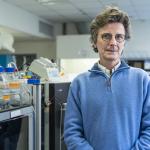

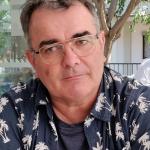

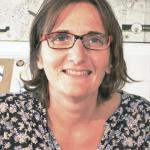

Our other strategic and operational monitoring bodies
The ITEM institute is governed by several complementary bodies. This gives impetus to the strategic and operational dynamics of the ITEM institute
The ITEM institute is administered by the Institute Council, which approves the main guidelines in terms of research, training and innovation.
The Institute Council is chaired by the institute Director. It meets at least twice a year.
It comprises members entitled to vote and those with an advisory capacity:
- Members entitled to vote: Equal representation of the faculties (college 1) and laboratories (college 2) involved in the Institute project. The Directors of the Units/Faculties or their representatives sit on the council.
College 1 comprises the directors (or their representatives) of the institute’s member faculties: OSU Pythéas, ALLSH (Faculty of arts, letters, languages and human sciences), IMPGT (Institute for public management and territorial governance), Faculty of medical and paramedical sciences, MMSH (Mediterranean centre for social sciences and humanities), Faculty of law and political sciences, Faculty of Science.
College 2, comprising the directors (or their representatives) of the institute’s member laboratories: CEREGE (European research and teaching centre in environmental geosciences), IMBE (Mediterranean institute of marine and terrestrial biodiversity and ecology), LPED (Population environment development laboratory), MIO (Mediterranean institute of oceanography), RECOVER (Risks, ecosystems, vulnerability, environment, resilience), BIAM (Aix-Marseille biosciences and biotechnologies), CERGAM (Aix-Marseille centre for management studies and research), DICE (Comparative and European international law), ESPACE (Study of structures, adaptation processes and changes in space), LCE (Laboratory of environmental chemistry), TELEMME (Time, space, language in southern Europe and the Mediterranean), LIEU (Interdisciplinary laboratory for urban planning), MESOPOLHIS (Mediterranean centre for sociology, political science and history).
The principle of parity of votes between the two colleges is guaranteed.
- Members with a legal advisory capacity: The Director of the Institute (RST), the Project Manager, the Director of the Aix-Marseille Université Doctoral College
- Members in an advisory capacity by appointment: 1 full and 1 alternate student and doctoral student representative, the institute’s Deputy Directors for Training and Research.
The student and PhD student representatives will be appointed by the Institute Director on the recommendation of the assembly of students in the institute’s programme and PhD students funded by the institute.
Quorum: reached when half of the votes are represented.
Vote: The decisions of the Institute Council are subject to a vote and are taken by a simple majority of its members with voting rights, present or represented
ROLE OF THE EXECUTIVE COMMITTEE
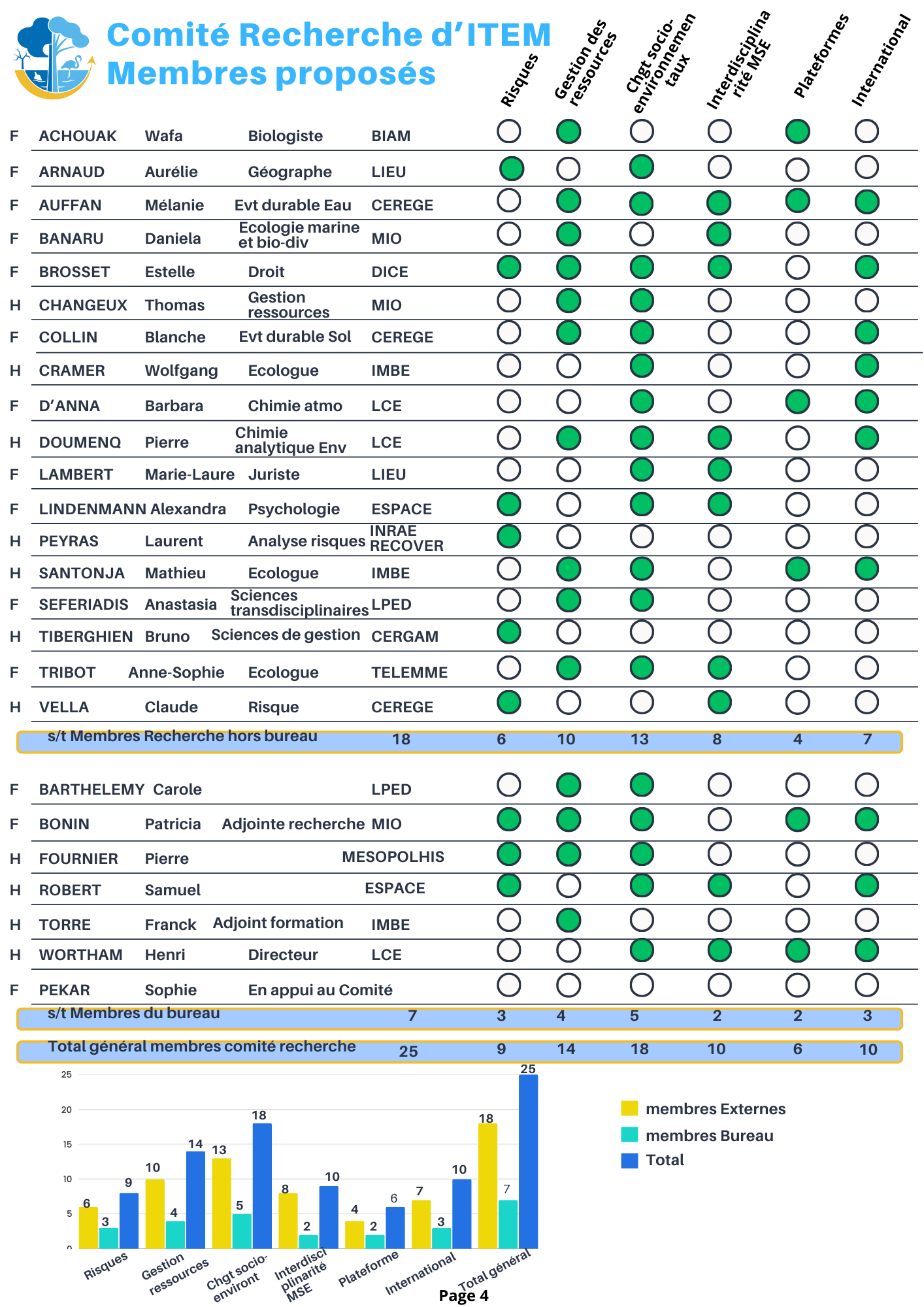
The ITEM institute Executive Committee comprises 2 committees, in accordance with A*Midex provisions: the Research Committee and the Training Committee.
-
Committee membership
Research Committee:
- Volunteer ITEM members (from a laboratory or faculty) who identify with ITEM’s research fields and would like to help run them.
- Areas of research: Analysis of socio-environmental changes | Resource management | Resilience of societies to risks
- Interface | Interdisciplinarity | Links with the Socio-Economic World
- Observation | Platform
- International
- Members of the board
Training Committee:
- All the heads of training courses within the scope of ITEM
- Members of the board
--> Depending on the subject, experts from outside the committees may be invited.
-
Missions
The Executive, Research and Training Committees decide on the institute’s scientific, educational, technical and operational guidelines, which they submit to the Institute Council for approval. The Executive, Research and Training Committees help to unite and promote the ITEM community in all the institute’s activities.
Focus on the research committee:
- Leads the ITEM community in major research programmes, whether local, national or international (coordinating and structuring a joint response, providing expertise in setting up projects between laboratories within ITEM’s scope)
- Rules on the strategic direction of the Calls for Research Projects, which the Executive Committee then drafts.
- Via ad hoc committees, proposes a reasoned selection made purposefully and based on reasoned criteria for Transition in Action, Internships and Mobility projects to be submitted to the Institute Council for funding.
- Implements an engineering action to monitor and support research projects funded or supported by ITEM
- Participates in the scientific evaluation of activity reports.
- Initiates and manages opportunities with the socio-economic world
Focus on the training committee:
- Federates the ITEM community around training issues related to the Environmental Transition
- Rules on the strategic direction of the Calls for Training Projects, which the Executive Committee then drafts.
- Via ad hoc committees, proposes a selection made purposefully and based on reasoned criteria for calls for projects related to training (in particular field schools) to be submitted to the Institute Council for funding.
- Proposes an annual review of training activities, particularly field schools
- Implements and ensures the smooth operation of the TRIPS
The ITEM institute’s Scientific and Training Advisory Board (STAB) has five members, all national and international figures from outside the university. Their mission is to support the institute’s scientific and educational development by providing a critical and constructive outside view of the work being carried out.
STAB membership:
- Mrs Semia Cherif: Professor, University of Tunis El Manar, Tunisia
- Mr Youssef Diab: Professor, Scientific Director of the Ecole des Ingénieurs de la ville de Paris, Université Paris-Est-Marne-la Vallée, France
- Mrs Agnès Jeanjean: Professor, Laboratory of Clinical, Cognitive and Social Psychology and Anthropology, LAPCOS, Université Côte d’Azur, France
- Mrs Séverine Kirchner: Research and Development Department CSTB, Scientific and Technical Centre for Building, France
- Mr Gilles Pinay: Research Director, Deputy Scientific Director INEE, Institute of Ecology and Environment, CNRS, France
Find out more about the institute
Missions
Aims of the institute, presentation videos, geographical sites
Ecosystem
Laboratories, faculties, doctoral schools...